


The 4:00 PM Sprint: The Chaotic, Beautiful Reality of Being a Working Mom in Israel
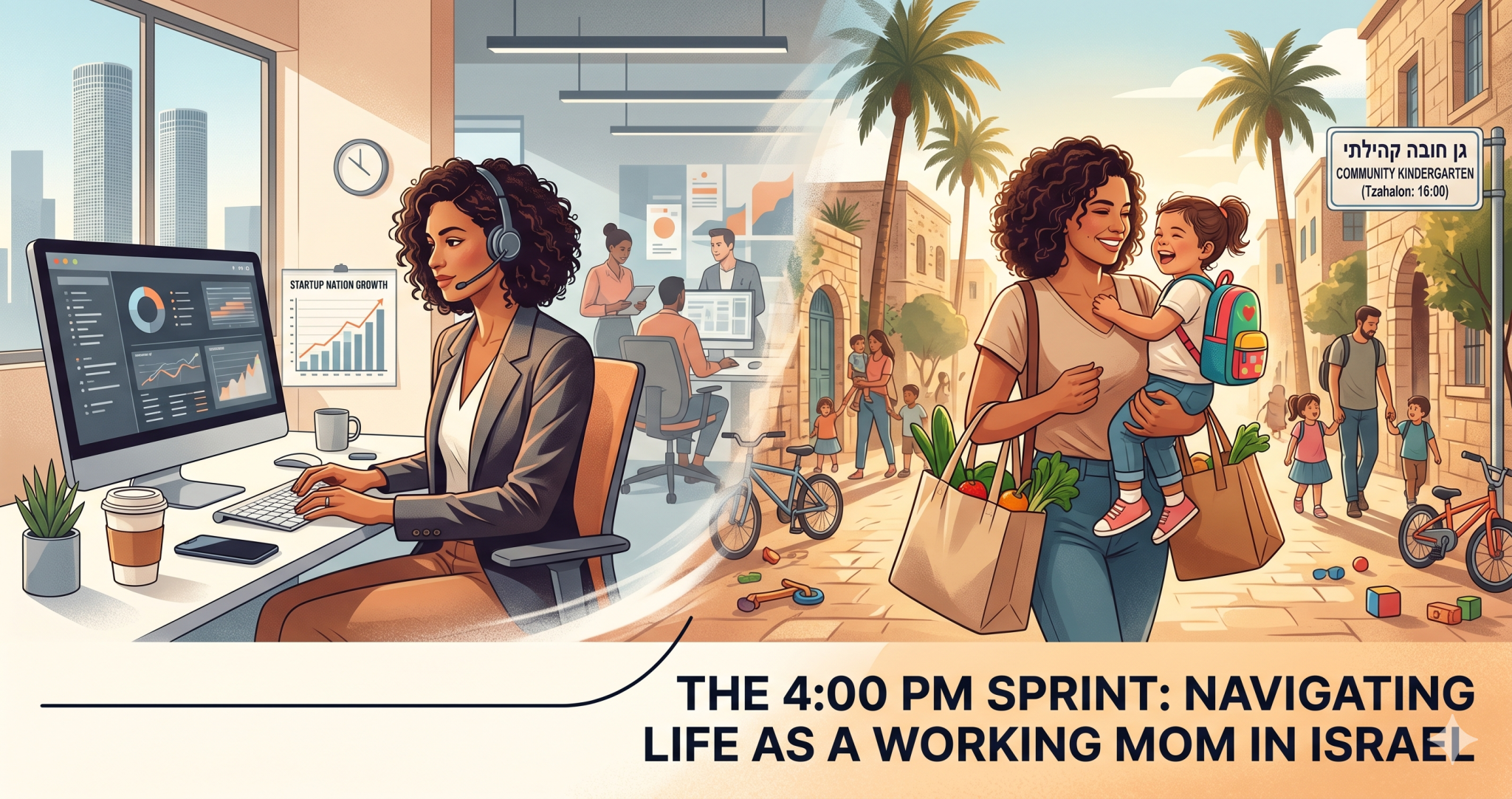
There is a distinct, collective shift that happens across Israeli office spaces every single day at roughly 3:45 PM. Keyboards clatter a little faster. Eyes dart nervously to the bottom right corner of computer screens. Bags are packed with military-level precision.
Then, the mass exodus begins.
Welcome to the phenomenon known across the country as Mishmeret Bet—”the second shift.” It’s the moment working mothers (and an increasing number of fathers, though let’s be real, it’s still predominantly moms) transition from high-powered professionals, startup engineers, and corporate managers into high-powered logistics coordinators for small, highly demanding humans.
Being a working mother is tough anywhere in the world. But being a working mom in Israel? That is a highly specific, uniquely intense sub-genre of existence.
The Numbers Game: High Fertility Meets High Ambition
In most OECD countries, high female labor force participation usually correlates with a lower birth rate. Women enter the workforce, climb the ladder, and naturally have fewer children.
Israel completely shatters this economic curve.
According to data from the Taub Center for Social Policy Studies, Israel has a uniquely high fertility rate (averaging around three children per woman) alongside exceptionally high employment rates for mothers, even those with toddlers. Non-Haredi Jewish couples work a collective average of 67 hours a week.
We don’t choose between a big family or a big career; Israeli society implicitly—and sometimes explicitly—demands that we achieve both. We are expected to grow the Jewish state while simultaneously scaling the ranks of the “Startup Nation.”
It is an cultural expectation that turns our calendars into a high-stakes jigsaw puzzle.
The Kindergarten Clock and the Culture Shock
For Olim (immigrants) or those looking at Israel from the outside, the daily schedule is a shock to the system. Standard Gan (daycare/kindergarten) ends at 1:30 PM. If you are lucky enough to secure a spot in a Tzahalon (after-school program), that buys you until 4:00 PM.
Think about that timeline. If your workday ends at 4:00 PM, and your commute involves the dreaded Ayalon Highway or a crowded train, you are constantly racing against a clock that is stacked against you.
And yet, Israel provides a bizarrely supportive environment for this chaos. In many Western corporate cultures, slipping out at 3:30 PM to pick up a sick kid is met with raised eyebrows and subtle career penalties. In Israel, family is an absolute religion. Your boss might be a tough-as-nails tech executive, but when your kid has a fever, they don’t just tell you to go home—they tell you to send updates.
There is an unspoken national contract: We work fiercely, but family comes first.
The “Village” is Real (and Loud)
You cannot survive as a working mother in Israel without a community, and thankfully, Israeli culture provides one out of sheer necessity.
-
The Grandparents (Savta and Saba): They are the infrastructure holding the Israeli economy together. If you see a toddler at a park at 2:00 PM, odds are they are with a grandmother who has stepped in so mom can finish her afternoon meetings.
-
The Gan WhatsApp Groups: A chaotic, 24/7 stream of consciousness where mothers crowdsource everything from missing left shoes to logistics for the upcoming Lag BaOmer bonfire. It is intense, it is noisy, but if you need a emergency pickup because you are stuck in a meeting, three other mothers will immediately offer to take your child.
-
The Chutzpah Advantage: Israeli kids are raised to be independent early. By first or second grade, it’s entirely normal to see children walking themselves home from school or navigating the neighborhood ice cream shop alone. This cultural embrace of independence is a survival mechanism for working parents.
The Burnout is Real, Too
We can romanticize the warmth of Israeli society all we want, but the structural pressures are taking a toll. Israel consistently ranks near the bottom of the OECD for work-life balance.
The pressure is even more acute in Israel’s demanding high-tech sector. Innovation Authority data highlights that while women’s participation in tech has grown over the last decade, representation has plateaued at around one-third of the workforce, and women still face a substantial wage gap. Balancing 10-hour startup days with the cultural expectation of being a present, hands-on mother who bakes homemade challah for the Gan on Friday morning is an exhausting tightrope walk.
And then there is the emotional weight unique to this region. Raising children in Israel means navigating geopolitical anxiety, reserve duty disruptions for partners, and the underlying knowledge of what our children will do when they turn 18. The mental load of an Israeli mother isn’t just about grocery lists and spreadsheet deadlines; it’s about resilience in the deepest sense of the word.
Embracing the Chaos
So, how do we do it?
We do it with a lot of coffee, a healthy dose of chutzpah, and by radically lowering our standards for what a clean house looks like. We learn to answer emails from our phones while sitting on a bench at the playground. We accept that dinner will sometimes be Bamba, sliced cucumbers, and cottage cheese eaten straight from the tub.
Being a working mom in Israel means living in a constant state of beautiful, noisy, exhausting friction. It is a life where your afternoon boardroom presentation is immediately followed by a negotiation with a stubborn three-year-old over a chocolate milk bag.
It isn’t perfect, and the system needs structural reform—longer school days and better pay equity would be a great start. But as we sprint out of our offices at 3:45 PM to make the pickup on time, there’s a strange comfort in knowing that the woman sprinting next to us completely understands the assignment.
We are building the future of this country, one boardroom meeting and one playground meltdown at a time.